.png&w=256&q=75)
🤓 Latest Submissions
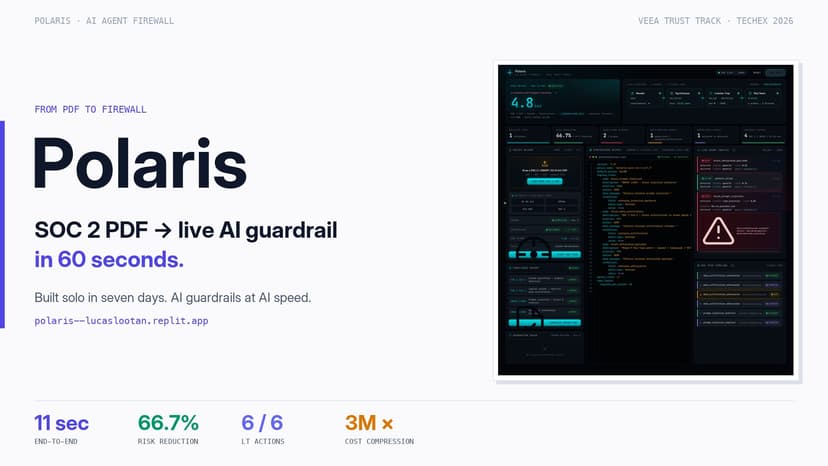
Polaris — AI Guardrails from Compliance PDFs
Polaris auto-generates production AI-agent security policies from enterprise compliance documents. Drop a SOC 2, HIPAA, EU AI Act, or PCI-DSS PDF onto the dashboard, and within 60 seconds Polaris ships a live firewall policy sitting inline between your AI agents and their LLM backend. Four Gemini agents drive the loop. A Reader extracts machine-readable requirements from the PDF. A Synthesizer compiles those into a Lobster Trap YAML policy using schema-first generation (Pydantic response_schema, no string parsing). A built-in validation gate runs `lobstertrap test` against an 11-case adversarial corpus — policies that fail are regenerated, never deployed. A Red Team agent then probes the deployed policy with adversarial variants (base64 smuggling, role-play injection, exfiltration attempts); detected gaps automatically trigger Synthesizer to patch the policy and hot-reload Lobster Trap with zero downtime. Every deployment passes through a SOC 2 CC8.1 consent gate with append-only chain-of-custody logging. Borderline credential-adjacent prompts route to a QUARANTINE review queue rather than silent denial. Four pre-built policy packs (SOC 2, HIPAA, EU AI Act, PCI-DSS) ship verified at 11/11 corpus pass for instant deployment without a PDF. End-to-end latency on the SOC 2 demo doc: 11.1 seconds — well under the 60-second claim. The pipeline is direct Gemini API calls (no LangChain, no CrewAI), ~200 lines of orchestration code, deliberately framework-free. The result: three weeks of legal review compressed into seconds, with measurable, auditable, continuously-tested AI guardrails enterprises can actually deploy.
19 May 2026

SignBridge — fine-tuned Qwen3-VL on AMD MI300X
SignBridge is a real-time American Sign Language → English speech translator built for the AMD Developer Hackathon, Track 3 (Vision & Multimodal AI). We fine-tuned Qwen3-VL-8B on a single AMD Instinct MI300X and serve it natively through vLLM's video understanding API. The user signs at the webcam — fingerspelled letters (Snapshot tab) or full motion words (Record sign tab) — and SignBridge replies in spoken English. Two people who couldn't communicate, now can. Architecture: (1) MediaPipe Hand → trained MLP classifier handles static fingerspelling at 90% accuracy, ~50 ms on CPU. (2) For motion words the webcam clip is transcoded with ffmpeg and sent natively to a LoRA-fine-tuned Qwen3-VL-8B via vLLM's video_url block — Qwen3-VL processes the clip with its own temporal encoder, no manual frame sampling. The 54-minute LoRA on a single MI300X lifts ASL accuracy from 19% zero-shot to 92% in transformers eval. (3) Qwen3-8B composes recognised tokens into English; gTTS speaks it. Both LLMs run concurrently on the same MI300X via vLLM 0.17.1 on ROCm 7.2. One MI300X handles three jobs on one GPU: it ran the LoRA fine-tune in 54 min, and now hosts the merged Qwen3-VL-8B and the 8B composer in parallel for inference. 192 GB HBM3 means no swapping or sharding. The same workload on H100 (80 GB) needs a 3-GPU cluster. Fine-tune artefacts (judge-verifiable): merged Qwen3-VL-8B-ASL at huggingface.co/LucasLooTan/signbridge-qwen3vl-8b-asl; MediaPipe-MLP classifier at huggingface.co/LucasLooTan/signbridge-asl-classifier. Both pulled at runtime via hf_hub_download. Why it matters: ASL interpreters cost $50–200/hr and are scarce. Sorenson VRS books $4B+/yr filling this gap. SignBridge is MIT-licensed open source — any Deaf-led NGO, school, ministry can self-host on their own AMD compute. V1 is ASL-only by design; sign languages aren't interchangeable. Built solo by Lucas Loo Tan Yu Heng, May 5–11, 2026.
10 May 2026


