
🤓 Latest Submissions

AsBuilt Lens: Autonomous Visual QA
Visual quality control in manufacturing is usually a nightmare because you have to train custom vision models for every single part. I wanted to see if we could completely eliminate the training phase using large Vision-Language Models. AsBuilt Lens is a dual-agent system running on the AMD MI300X. It takes a live camera feed (we wrote a custom OpenCV script to auto-capture when the object is perfectly still) and sends it to the first agent, the "Visual Inspector". This agent gets a natural language prompt (like "check if there are 4 resistors and 1 capacitor") and returns a sturctured JSON with bounding boxes and counts. If everything passes, it stops there. But if something fails, the code does an autonmous handoff to Agent 2, the "Quality Engineer". This agent looks at the failure and reasons about the root cause (e.g., is it a physical defect or a missing part?) and generates a corrective action plan. Running this required a massive model (Qwen3-VL-32B). Doing this on standard GPUs would need heavy quantization, but thanks to the 192GB of HBM3 on the MI300X, we ran it natively in FP16 using vLLM and ROCm. The reasoning speed and visual precision is honestly incredible.
10 May 2026
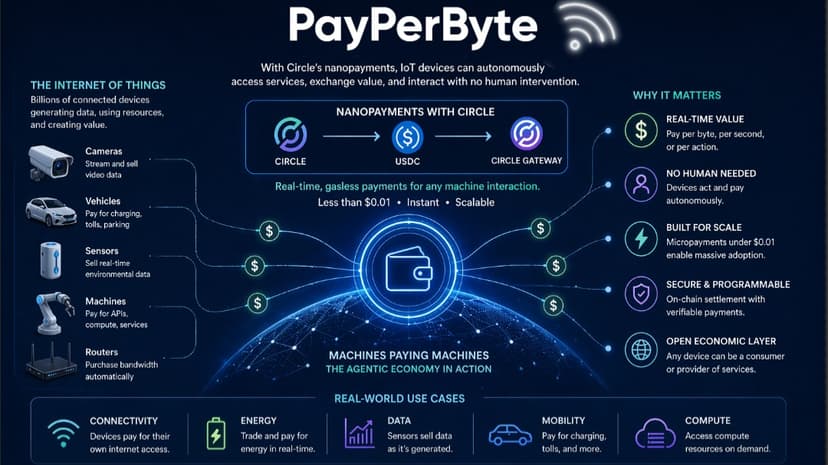
PayPerByte: Bandwidth Agent for IoT
PayPerByte is a physical demo of how the Agentic Economy can work in the real world. I built a laptop that acts as a Seller Agent, it creates a WiFi hotspot and sells internet per MB to industrial IoT robots using USDC nanopayments on Arc. The idea came because I see IoT and robots as the real future. These devices work offline most of the time collecting sensor data, but every now and then they need to send a bigger report, get an update, or sync with the cloud. Paying for constant WiFi is expensive and overkill. They should only pay for what they actually use. So I made it simple: the robot stays offline, and when it needs to send data, it automatically connects to my hotspot, signs the payment off-chain, pays tiny amounts via Circle, gets temporary access through iptables, uploads what it needs, and disconnects. Right now I have a live dashboard showing off-chain signatures, MB consumed, and the seller’s gateway balance updating. What makes this different from most projects here is that it’s not another web simulation, it’s real hardware controlling real bandwidth for real IoT use cases. I think this is the kind of infrastructure we’re going to need when thousands of autonomous devices start moving around factories, farms, and cities.
26 Apr 2026


