.png&w=256&q=75)
Gulnaz nawaz@GulnazNawaz
4
Events attended
3
Submissions made
Pakistan
1 year of experience
About me
Graphic Designer
Socials
🤝 Top Collaborators


🤓 Latest Submissions
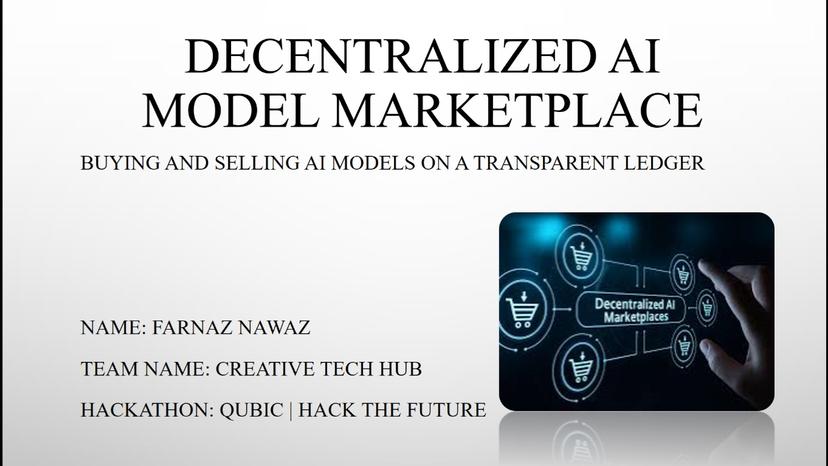
Decentralized AI Model Marketplace
The Decentralized AI Model Marketplace is a platform hosted on the Qubic blockchain, designed to facilitate a peer-to-peer ecosystem for artificial intelligence services. It utilizes Qubic's high-performance, decentralized compute layer to run AI models without relying on centralized data centers. Model creators register their AI algorithms (like image recognition or sentiment analysis) via smart contracts. Users then submit data to these models and pay a micro-transaction fee in Qubic tokens. This system efficiently connects those needing AI capabilities with those providing computational resources, ensuring transparency, censorship resistance, and fair compensation for all network participants, thus democratizing access to AI power.
7 Dec 2025
Smart Task Automation Agent for Engineers
Engineering teams work with large volumes of documents such as FEED reports, maintenance logs, design notes, safety reviews, and technical assessments. Manually analyzing these documents requires engineers to spend hours reading, identifying issues, summarizing findings, preparing checklists, and drafting email updates. These tasks are repetitive, time-consuming, and often delay critical project decisions. To address this challenge, the Smart Task Automation Agent leverages the capabilities of IBM watsonx Orchestrate to automate the entire engineering review workflow. The agent intelligently reads engineering documents uploaded by the user, detects key issues, extracts essential technical information, and generates actionable engineering checklists. It also prepares a polished email summary that can be directly shared with supervisors or team members. This automation significantly reduces manual effort and enhances both speed and accuracy in engineering tasks. Instead of spending hours reviewing content, engineers can obtain structured insights within seconds. The agent ensures more consistent reporting, faster communication, and improved decision-making. By combining AI-driven document understanding with automated workflow execution, this project demonstrates how agentic AI can transform engineering operations. It is particularly useful for industries like petrochemicals, manufacturing, construction, energy, and utilities where documentation and reporting are critical. The Smart Task Automation Agent ultimately streamlines engineering processes, boosts productivity, and enables teams to focus on high-value design and problem-solving activities while the AI handles routine work efficiently.
23 Nov 2025
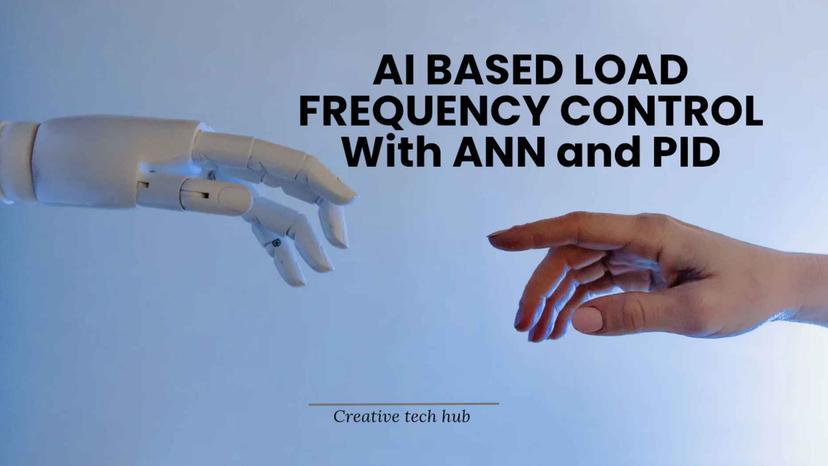
AI-based Load Frequency Control with ANN and PID
This project explores the use of artificial intelligence for load frequency control (LFC) in a single-area power system. Keeping system frequency stable is vital for reliable electricity supply, as sudden load changes can cause deviations that threaten grid stability. Traditional controllers like PID (Proportional-Integral-Derivative) can correct frequency deviations, but they often struggle with nonlinearities and complex system dynamics. Here, a feedforward Artificial Neural Network (ANN) is trained to predict the next frequency deviation using recent historical data of frequency and load. The ANN controller adjusts the mechanical power input in real time to minimize these deviations. Training data is generated from numerous random load profiles to simulate realistic disturbances. The performance of the ANN controller is compared with both open-loop (no control) and classical PID control. Results show that the ANN achieves better frequency regulation, with lower root mean square (RMS) deviations and smoother responses. Graphs of frequency, mechanical power, and load clearly demonstrate the ANN’s ability to handle disturbances more effectively than PID. This work highlights the potential of machine learning in modern power system control, offering an adaptive and robust approach to frequency regulation. Future work could extend this to multi-area systems, use recurrent neural networks for better temporal modeling, and explore reinforcement learning for optimal control strategies.
19 Nov 2025


