.png&w=256&q=75)
🤓 Latest Submissions
Incident Commander
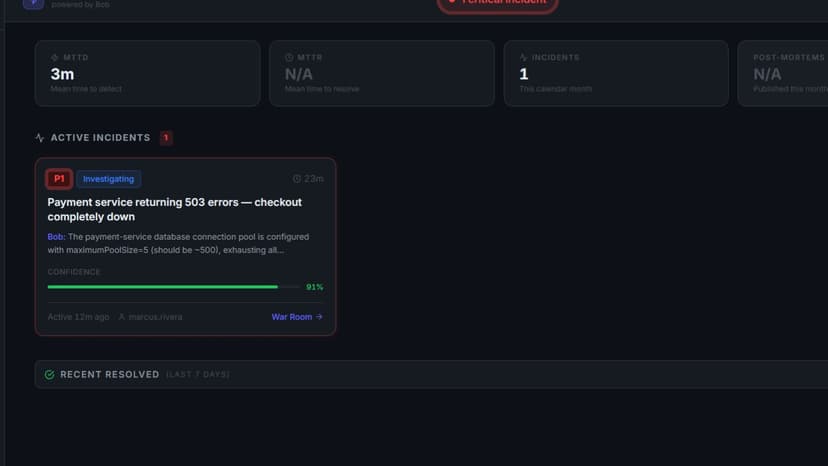
Production incidents are chaotic and expensive. When something breaks in production, on-call engineers face a wall of noise — thousands of log lines, a flooded Slack, outdated runbooks, and no clear starting point. The average team spends 45 minutes just understanding what's broken before they can begin fixing it. Incident Commander changes that. It is a real-time incident response war room dashboard that uses IBM Bob as its core reasoning engine. When an incident is triggered — either by an alert or manually by an engineer — the team ingests signals: raw logs, recent git commits, deployment history, runbooks, and past incident reports. Bob reads all of these simultaneously and produces, in under 60 seconds: - A plain-English explanation of what is broken - A ranked list of root cause hypotheses, each backed by specific evidence from the ingested signals - Step-by-step remediation actions pulled from runbooks and past incidents - Who to page and why - What to monitor to confirm the fix is working What makes this different from existing tools like PagerDuty or Grafana is that those tools show you data — Bob reasons across it. Bob holds the full context of logs, code changes, deployment timeline, and historical patterns simultaneously, connecting dots that a human reading linearly would miss or take hours to find. As the incident progresses and new signals are added, Bob continuously updates its hypothesis — each time building on its previous analysis rather than starting from scratch. The live timeline tracks every signal, every Bob update, and every human action in real time via WebSockets. Once the incident is resolved, Bob automatically generates a complete blameless post-mortem — timeline, root cause, contributing factors, lessons learned, and prioritized action items — ready for human review and publishing.
17 May 2026

