.png&w=256&q=75)
🤓 Latest Submissions
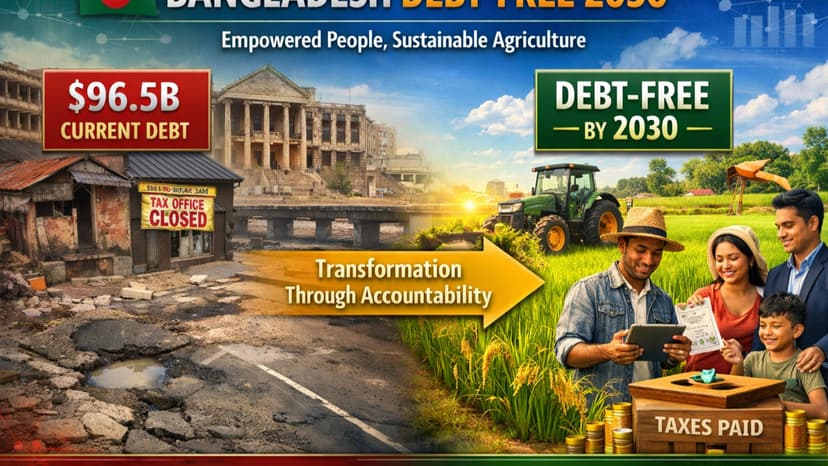
Bangladesh Debt-Free by 2030
Bangladesh faces a $96.5B national debt crisis, but data reveals a deeper truth: $23.85B (24.7%) of this debt was avoidable through better governance and economic management. Our analysis exposes three structural failures: Infrastructure Overpayment ($15.15B): Bangladesh pays 2–4× global benchmarks. Padma Bridge: 2.89× India’s cost Dhaka Metro: 3.94× Delhi Metro (same funder) Rooppur Nuclear: 3.01× India’s plant These patterns emerge from comparisons with 30+ global projects. Import Inefficiency ($8.7B): Imports grew 664% (2000–2024) to $67.88B, driven by fuel, food, and manufactured goods. A realistic 20% substitution strategy could save $13.6B annually. Agricultural Productivity Crisis: 44.7% of workers produce only 11.2% of GDP 31.7M people earn $1,526/year Productivity is 40.7× lower than developed nations Represents $1.9T in untapped potential These failures create a cycle of corruption, low productivity, weak tax revenue, and rising debt. Our Solution We built a data‑driven transparency platform that: Uses 25 years of World Bank data, 431 import data points, and global infrastructure benchmarks Identifies $23.85B in avoidable debt Reveals the agricultural productivity gap Provides 6 revenue solutions worth $21B+/year Projects full debt elimination in 4.6 years Why It Matters This platform: Exposes corruption with hard evidence Offers actionable, revenue‑backed solutions Shows how agriculture alone could erase debt in 30 years Empowers policymakers, development partners, and citizens Demonstrates a replicable model for developing nations At its core, this is about transparency, economic sovereignty, and transforming 31.7 million lives through data‑driven reform.
17 May 2026


