.png&w=256&q=75)
🤝 Top Collaborators
.png&w=640&q=75)
🤓 Latest Submissions

SentinelLens
The Problem Enterprises are aggressively adopting AI tools, but they face a massive blind spot: no one is watching what employees send to these models. Every day, sensitive data—client financial figures, AWS credentials, and confidential M&A details—is accidentally leaked into public LLMs. Traditional Data Loss Prevention (DLP) tools rely on outdated, static regex patterns and completely miss the semantic context of natural language. The Solution: SentinelLens SentinelLens is an autonomous Agentic Security Firewall built for the TechEx Hackathon. Powered by Google Gemini 2.5 Flash Lite, it acts as a Trust Layer proxy sitting between your employees and external AI systems. Key Features: 1. Intelligent Prompt Interception: When an employee submits a prompt, SentinelLens intercepts it. Gemini semantically analyzes the text, detects sensitive entities (PII, IP, Credentials), assigns a risk score (0-100), and autonomously decides whether to ALLOW, SANITIZE, or BLOCK the request. 2. Real-Time SOC Dashboard: Security teams get a premium, dark-mode dashboard providing live telemetry on risk distributions, actions taken, and departmental AI usage. 3. Knowledge Gap Engine: Instead of just blocking users, SentinelLens groups unsafe queries to identify organizational training gaps (e.g., "15 employees leaked GDPR data -> Trigger Compliance Training"). 4. Natural Language Policy Studio: Security engineers can type rules in plain English (e.g., "Block all AWS keys"), and Gemini instantly converts them into structured YAML firewall rules. Hackathon Track Alignment: Track 1 (Agent Security): We built a purpose-built AI governance agent that intercepts, sanitizes, and audits enterprise AI traffic. Track 2 (Google AI Studio): We utilized Gemini 2.5 Flash Lite as the core reasoning engine for deep prompt inspection and zero-shot entity detection.
19 May 2026

HealOps: Agentic Runtime Firewall
The Problem: The Staging Bottleneck In modern software development, when a bug crashes the Staging or QA environment, the entire testing pipeline grinds to a halt. QA engineers are blocked from continuing their work, and developers are forced to painfully break their flow state, context-switch, dig through server logs, write a hotfix, and wait for a new deployment. This cycle drains productivity The Solution: Agentic Auto-Remediation Our project introduces an Agentic Runtime Firewall that acts as an active guardian over your application. Instead of just logging errors, the firewall intercepts fatal runtime crashes (like Null Pointer Exceptions) the millisecond they occur. The Tactical Fix (Zero-Downtime Hot-Patching): The firewall captures the stack trace and sends it to IBM Bob, along with the full repository context. Bob instantly generates a safe fallback function, which the firewall injects directly into the running Node.js memory. The server is healed in real-time, keeping the staging environment alive and the QA team completely unblocked. The Developer Workflow (Agentic PR): Healing the symptom isn't enough. Simultaneously, IBM Bob analyzes the root cause of the crash and drafts a permanent code fix along with regression tests. It automatically opens a Pull Request in GitHub, allowing the developer to review and merge the fix the next morning without ever having their workflow interrupted. Meaningful Use of IBM Bob Unlike standard LLMs that only see isolated code snippets, this solution deeply relies on IBM Bob's Agentic Development capabilities. By leveraging Bob's full-repository context, the generated hot-patches are contextually aware of the surrounding application state, ensuring the memory injection is safe, accurate, and perfectly tailored to the codebase. Business Value By combining dynamic runtime patching with agentic PR generation, we eliminate QA downtime, protect developer flow states, and dramatically accelerate the software delivery lifecycle.
17 May 2026
ALCHEMY
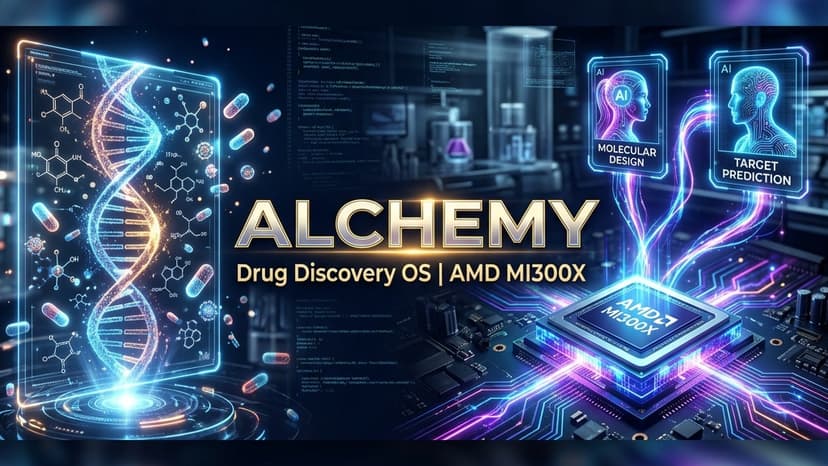
The Problem: Traditional drug discovery takes over a decade and costs $2B+, with a devastating 90% clinical failure rate. The core bottleneck: disconnected data silos and the inability to rapidly predict drug-target binding while simultaneously auditing for human toxicity. The Solution — ALCHEMY: We built ALCHEMY, an agentic operating system that mimics a real-world pharmaceutical lab. Enter a disease (e.g., "Alzheimer's disease"), and ALCHEMY autonomously orchestrates the entire discovery pipeline: Target Agent: Queries UniProt to identify the exact protein sequences responsible for the disease. Repurposing Agent: Scans a FAISS vector database of 1,000+ FDA-approved drugs in milliseconds using custom 1280-dimensional protein embeddings. PharmaDuel (The Swarm): Two autonomous AI agents — a BioChemist (proposer) and a Toxicologist (critic) — debate drug safety and efficacy in real-time, aggressively filtering out toxic candidates through adversarial reasoning. Hardware & AMD Integration: This project pushes the limits of AMD Instinct MI300X GPUs and ROCm 6.1: Native Fine-Tuning (Track 2): We leveraged the 192GB VRAM of the MI300X to fine-tune a 650M parameter ESM2 protein language model. To overcome NaN gradient collapses common in protein transformers, we bypassed mixed precision and trained entirely in FP32 — achieving 77.6% validation accuracy with stable exponential loss decay. Agentic Workflows (Track 1): The PharmaDuel orchestration relies on Qwen2.5-72B running locally on AMD hardware for blazing-fast reasoning and debate generation. Vector Embeddings: The entire drug database was re-embedded into a 1280-dimension vector space using our fine-tuned model directly on the MI300X. ALCHEMY proves that with AMD's cloud infrastructure, a small team can compress the full computational pipeline of a pharmaceutical company into an interactive, real-time dashboard — accelerating drug discovery from years to minutes.
10 May 2026


