.png&w=256&q=75)
🤝 Top Collaborators
.png&w=640&q=75)


🤓 Latest Submissions
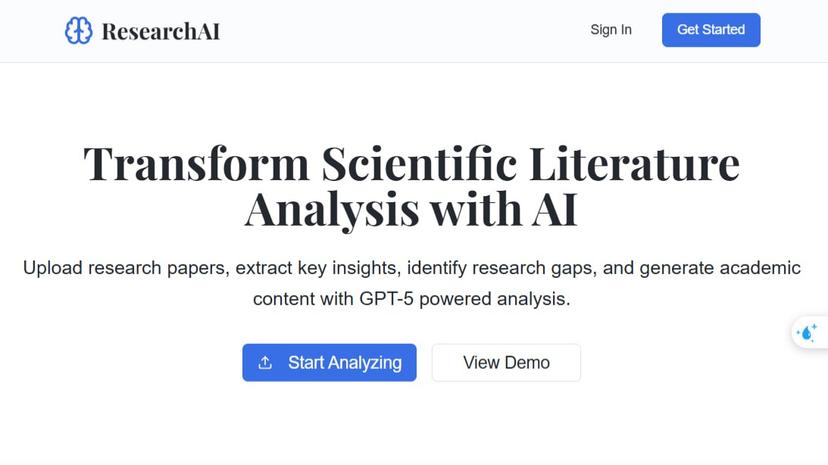
Scientific Literature Analysis Platform
ResearchAI is a comprehensive web application designed to streamline the academic research process. It empowers researchers, students, and academics to manage, analyze, and interact with scientific papers more effectively. Users can upload PDF documents, and the system will automatically process and index them. The platform offers several key features: AI-Powered Analysis: Leverages AI models to perform in-depth analysis of research papers, helping to identify key findings, methodologies, and potential research gaps. Interactive Chat (RAG): Includes a sophisticated "ask anything" feature that allows users to have a conversation with their documents. The system uses Retrieval-Augmented Generation (RAG) to provide accurate, context-aware answers based on the content of the uploaded papers. Content Generation: Assists with academic writing by providing tools to draft content, generate outlines, and summarize complex information. Project and User Management: Features a full dashboard for managing projects, tracking analysis history, and handling user authentication. The application is built with a modern tech stack, featuring a Next.js frontend for a responsive user experience and a robust FastAPI backend to handle file processing and AI-powered analysis.
24 Aug 2025
.png&w=828&q=75)
AI Voice Powered Restaurant Assistant
Agentic Foodie is a voice-powered restaurant ordering app built using Streamlit for the frontend UI. It features a modern interface for browsing the menu, recording voice input, and managing orders. Key Streamlit components like st.columns, st.button, and st.session_state handle layout and interaction, while custom CSS enhances styling and responsiveness. audio_recorder_streamlit enables in-browser audio recording, returning WAV bytes. These are processed with pydub (AudioSegment) and speech_recognition (Recognizer with recognize_google) to convert audio to text for voice-based interactions. Groq API (LLaMA 3) provides the core NLP via HTTP requests made using the requests library. The app sends user messages and history to the API and receives structured JSON responses with intents, item IDs, quantities, and replies. Rate-limiting is managed using x-ratelimit-remaining-requests and timestamps with the time module. JSON is used throughout for defining menus, promotions, and exchanging data with the Groq API. The io module (io.BytesIO) handles in-memory audio processing for seamless transcription. A custom Multi-agent Control Plane (MCP) organizes tasks like checking availability and suggesting items. Agents are registered using decorators (e.g., @inventory_agent.task) and simulate modular multi-agent interactions. Overall, this tech stack enables an AI-driven, interactive restaurant ordering experience with support for voice input, menu browsing, upselling, and conversational responses — all in a sleek, real-time Streamlit app.
8 Jul 2025

SupplyShield - Smart Risk Detection
SupplyShield 2.0 is an AI-powered logistics intelligence system designed to monitor global shipments in real time, detect risks proactively, and automate decision-making and communication to reduce costly disruptions. Supply chains today face unpredictable events — weather delays, port strikes, roadblocks, and geopolitical risks — yet most systems rely on manual reporting, slow updates, and siloed communication. These gaps lead to delayed actions, misinformed stakeholders, and massive financial losses. SupplyShield 2.0 solves this with a full-stack AI-driven dashboard that uses real-time inputs (shipment logs, weather, news) to identify potential disruptions. It uses Claude LLM via Anthropic to summarize risks, suggest optimal decisions (like rerouting or expediting), explain severity levels, and even draft professional messages or Slack updates for stakeholders — automatically. The system is built using Streamlit for interactive visualization, LangChain + LangGraph for smart logic flows, and ChromaDB to store historical decisions and learn from them. It integrates OpenWeatherMap, GNews, and Slack Webhooks, providing a 360° view of each shipment — including weather at its current location, breaking news alerts, AI-generated risk summaries, and cost comparisons between action choices (e.g., penalty vs air freight vs rerouting). Users can upload new shipment entries or choose from samples. The app allows for one-click PDF and CSV report exports and features an internal chatbot interface that remembers the current session. It is built with modular architecture, real-time visuals (Plotly maps and charts), memory-driven chat, and customizable alerts. By automating insight, communication, and contingency logic, SupplyShield 2.0 helps companies reduce operational losses, speed up decision-making, and improve reliability in their global supply operations. It combines the power of LLMs with logistics domain intelligence to build the next-generation smart supply chain layer.
1 May 2025


